
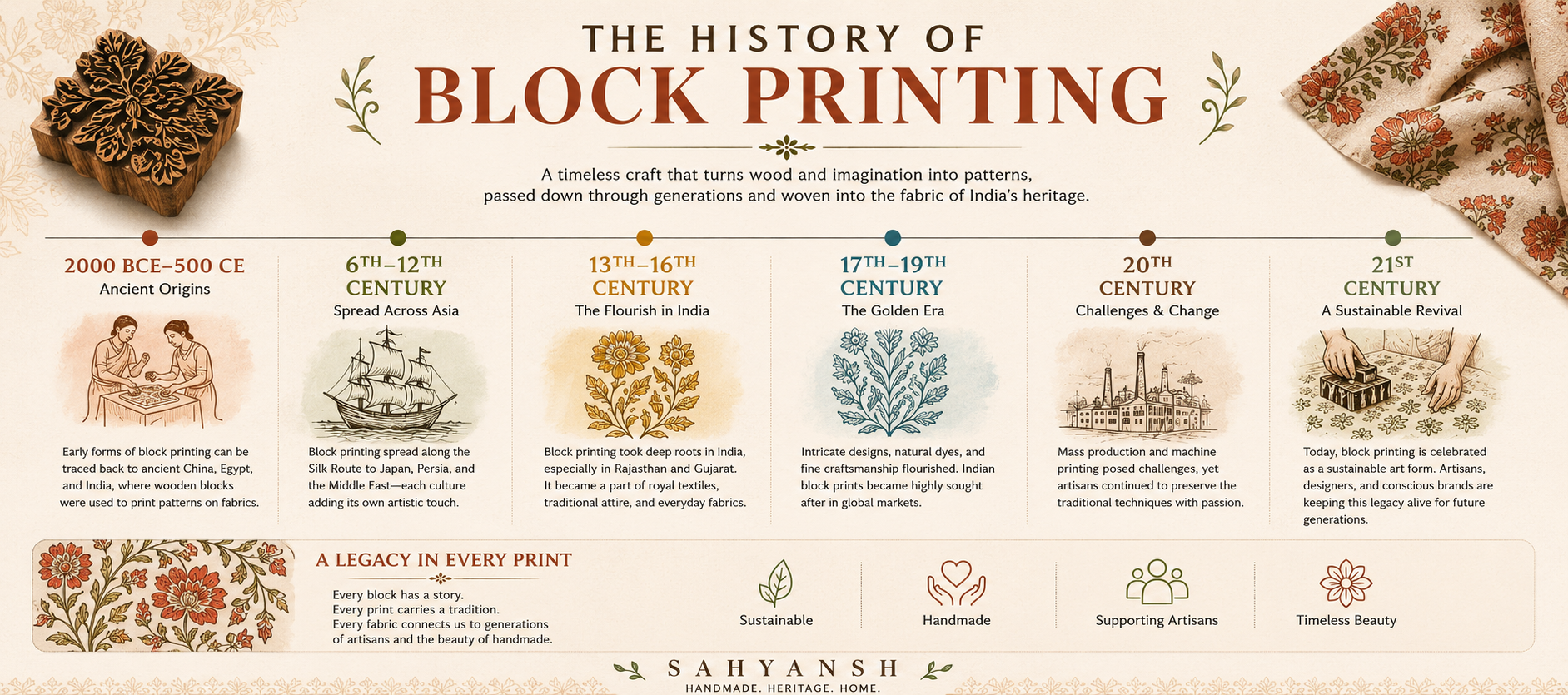
History of Jaipur Hand Block Printing: A 400-Year Legacy
Close your eyes for a moment. Imagine a craftsman seated in a sunlit workshop in Jaipur. A carved wooden block in his hands. One stamp at a time — a perfect floral motif appears across metres of pure white cotton, entirely by hand.
This is the history of Jaipur hand block printing. Not just a craft technique — but a living, breathing art form that has survived 400 years and is still very much alive today.
At Sahyansh, rooted in the legacy of Miyabajaj Razai Emporium, we carry this tradition into homes across India and around the world. This is the story of where it all began.
The Mughal Roots — Where It All Began
The story of Jaipur hand block printing begins in the courts of the Mughal emperors — some of the greatest patrons of art and craftsmanship the world has ever seen.
In the 16th and 17th centuries, the Mughal court invited master craftspeople from Persia and Central Asia to settle in India. These artisans brought with them the ancient technique of block printing — pressing carved wooden stamps dipped in dye onto fabric to create repeating patterns.
Indian artisans absorbed this technique and transformed it entirely. They combined it with local traditions, natural Indian dyes, and motifs inspired by Mughal gardens — flowing flowers, delicate paisleys, intricate geometric patterns. A uniquely Indian art form was born.
How Jaipur Became the Heart of Block Printing
When Maharaja Sawai Jai Singh II founded the pink city of Jaipur in 1727, he established dedicated neighbourhoods — called mohallas — where artisan families could live, work, and pass their skills from one generation to the next.
Two towns near Jaipur became world-famous for their distinct printing styles:
| Sanganer Delicate floral patterns on crisp white backgrounds. Soft colours. Elegant designs that feel both timeless and contemporary. | Bagru Bold, earthy patterns using natural mud resist techniques. Rich terracotta, deep blacks, and warm ochres rooted in the Rajasthani landscape. |
The Making of a Block Print — A Process Unchanged for 400 Years
Here is something remarkable about Jaipur hand block printing: the process has barely changed since the Mughal era. The same tools. The same technique. The same patient, meditative rhythm of hand and block and fabric.
It begins with the block itself — a master craftsman carves a design into seasoned teak or sheesham wood, sometimes spending days on a single intricate motif. Next, pure cotton cloth is washed and stretched flat on a long padded printing table. Then the artisan dips the wooden block into natural dye and presses it firmly onto the fabric — one stamp at a time.
The slight variations you see in a hand block printed piece — tiny differences in pressure, tiny shifts in alignment — are not flaws. They are fingerprints. They are the proof that a real human hand made this, just for you.
The Colours of Jaipur — Nature's Own Palette
If the wooden block is the voice of Jaipur block printing, then natural dye is its soul. For centuries, Jaipur's block printers used colours drawn entirely from the natural world:
| Indigo Plant | Deep, dreamy blues that never seem to fade |
| Madder Root | Rich, warm reds and dusty pinks |
| Turmeric | Bright, sun-soaked golden yellows |
| Pomegranate Rind | Golden yellows that glow like afternoon light |
| Iron and Clay | Dramatic blacks and greys of Bagru's mud resist prints |
The GI Tag — India's Official Stamp of Authenticity
Jaipur Block Print is Officially Protected
Jaipur block printing holds a Geographical Indication (GI) tag — one of the most prestigious certifications the Government of India awards to traditional crafts. Only textiles genuinely produced in Jaipur using traditional hand block printing techniques can officially be called Jaipur block print. When you shop at Sahyansh, you are buying from a brand rooted in this GI-tagged tradition.
The Motifs of Jaipur — Every Pattern Tells a Story
One of the most beautiful things about Jaipur block printing is that every motif carries meaning. These are not random decorations — they are a visual language developed over centuries.
| Buta / Floral Cluster | Small bouquets of flowers inspired by Mughal palace gardens. The most iconic Jaipur motif. |
| Paisley (Kairi) | The graceful teardrop inspired by the mango — symbol of abundance and good fortune. |
| Jaal (Net Pattern) | An intricate lattice inspired by Mughal stone screens. A symbol of continuity and infinite beauty. |
| Leheriya (Wave Stripe) | A flowing diagonal stripe unique to Rajasthan — representing the rhythm of rivers and life. |
| Dabu Print | A mud resist technique from Bagru creating magical reverse patterns that feel ancient and modern. |
A Craft That Refused to Die
The industrial revolution tried to replace it. Fast fashion tried to copy it. Machines tried to replicate it. None of them succeeded.
Because no machine can replicate the soul of a hand block print. No factory can reproduce the subtle variation of a craftsman's touch. No algorithm can replace the generational knowledge that flows from a master artisan to his apprentice in a Jaipur workshop.
Brands like Sahyansh — rooted in the legacy of Miyabajaj Razai Emporium — exist to ensure this tradition does not just survive, but thrives. By connecting Jaipur's artisan families directly with homes across India and around the world, we keep the craft alive — one bedsheet, one quilt, one dohar at a time.
Bring 400 Years of History Into Your Home
Every Sahyansh piece is handcrafted by skilled artisans in Jaipur using traditional block printing techniques.
From hand block print bedsheets and dohars to quilts and cushion covers — each piece carries 400 years of Jaipur's heritage. We ship across India and worldwide.
Explore the Collection →For further reading on Indian textile heritage, visit the Craft Council of India and Wikipedia's overview of block printing in India.
-
 August 26th, 2026
 -
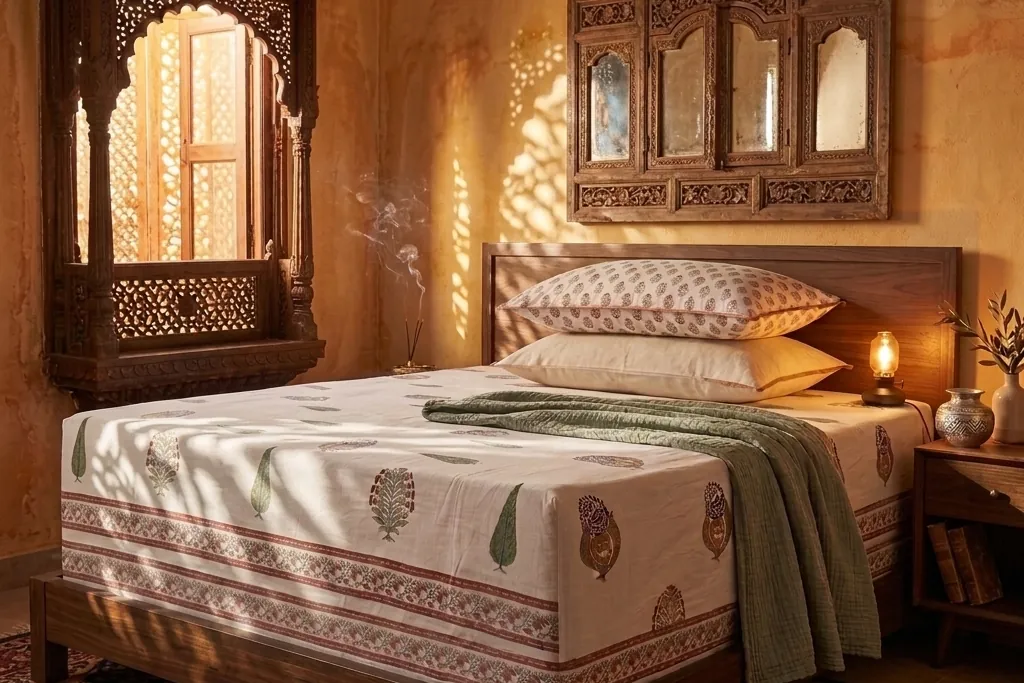
Fitted vs Flat Bedsheets: Why More Homes Are Making the Switch
July 25th, 2026 -
 July 22nd, 2026
 -
 July 18th, 2026
 -
 July 9th, 2026