
Hand Block Printing: Everything You Need to Know
Written by Miya Bajaj · Sahyansh · May 2026
Let me tell you something about the fabric on your bed
I grew up watching my grandmother run her fingers across printed fabric the way most people read a page — slowly, deliberately, like she was looking for something. She could tell in seconds whether a print was real or not. Not by any fancy test. Just by touch. Just by looking closely at where the pattern repeated.
That memory is part of why Sahyansh exists. And it's why I want to take a few minutes to tell you what hand block printing actually is — because once you understand it, you'll never look at a printed textile the same way again.
"A machine makes a pattern. A craftsperson tells a story."
So what is hand block printing, really?
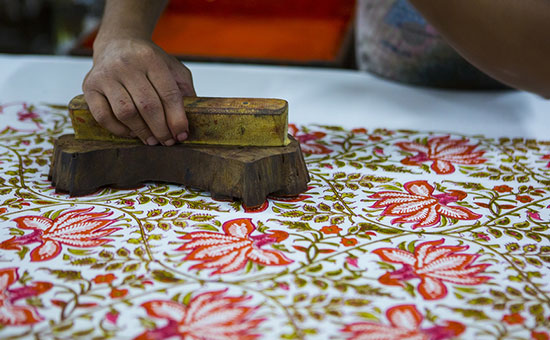
It's exactly what it sounds like — and also so much more than that. A craftsperson takes a block of wood, carved with a design by hand, dips it into dye, and presses it onto fabric. One stamp at a time. Hundreds of times across metres of cloth.
According to Wikipedia's history of block printing on textiles, this craft has roots going back thousands of years in India. But reading about it doesn't do it justice. The real thing — watching a craftsman in Bagru or Sanganer lay down a perfect floral repeat using nothing but his eye and his hands — that stays with you.
At Sahyansh, we bring this tradition into your home through bed linen, cushion covers, curtains, dohars, and more — all sourced directly from artisan families in Rajasthan.
How does a hand block print actually get made?
I find the process genuinely fascinating, so let me walk you through it:
- Block carving — A craftsman sits with a block of seasoned teak or sheesham wood and carves a motif into it by hand. A detailed block can take days. That single block will go on to print thousands of metres of fabric over its lifetime.
- Fabric preparation — The cloth — usually pure cotton, cambric, or linen — is washed and then soaked in a mordant solution. This is what helps the dye bond deeply into the fibre instead of just sitting on the surface.
- Dye preparation — This is where it gets really interesting. Natural dyes come from plants, minerals, and even mud. Indigo from leaves. Red from madder root. Yellow from turmeric or pomegranate rind. Rust from iron-rich soil. Each one has its own character.
- Hand printing — The craftsperson lays the fabric flat, dips the block, aligns it by eye against the last stamp, and presses down firmly. Then lifts. Then does it again. And again. For hours.
- Sun-drying — The printed fabric is spread out across open fields to dry in sunlight. If you've ever driven through Rajasthan and seen fields of colourful fabric drying under the sun — that's what this looks like.
- Washing and finishing — Finally the fabric is washed in running water, checked for quality, and finished into the product that eventually reaches your home.
How do you spot a genuine hand block print?
Honestly, this is the most important thing to know before you buy. The market is full of machine prints being sold as hand block prints. Here's how to tell the difference. You can also read more about the Bagru printing tradition to understand what authentic regional styles look like.
MYTH
Perfect repeats mean better quality.
Actually, it's the opposite. If every repeat is mathematically perfect, it came off a machine. A real hand block print has tiny shifts, slight overlaps, little gaps — because a human hand placed each one.
FACT
The small imperfections are the whole point.
Those little variations aren't flaws — they're fingerprints. They're proof that someone made this. No two hand block printed pieces are identical, which means what you have is genuinely one of a kind.
MYTH
Brighter colours mean higher quality.
Nope. Synthetic dyes scream. Natural dyes whisper. The colours from plant-based dyes are softer, warmer, more muted — and they have a depth that no chemical dye can fake.
FACT
Flip it over. The back tells the truth.
On a genuine hand block print, the reverse side will show a faint ghost of the pattern — because the dye has soaked into the weave. If the back is a stark, clean white, it's a machine print.
Why does any of this matter for your home?
I get asked this sometimes — why pay more for something handmade when a machine-printed version looks similar at first glance? Here's my honest answer:
They get better with age. I mean this literally. Natural dyes don't fade the way synthetic ones do — they deepen and soften with every wash. A bedsheet you buy today will look more beautiful in five years than it does now.
Every motif means something. The buta leaf motif comes from Mughal textile design. The leheriya wave is from Rajasthan. The dabu mud-resist pattern is specific to Akola. When you bring one of these into your home, you're bringing centuries of cultural memory with it. Your cushion cover has a story.
They're genuinely sustainable. Plant-based dyes, natural fibres, no industrial chemicals. Learn more about the history and science of natural dyes if you're curious — it's fascinating. The environmental footprint of a hand block printed textile is a fraction of what goes into mass-produced synthetic fabric.
They go with everything. Seriously. I've seen block print bedcovers look stunning in ultra-modern apartments and in traditionally decorated homes alike. There's something about the handmade quality that just fits.
How to take care of your block print textiles
This part matters. A little care goes a long way with hand block printed fabric:
- Cold water only — Hot water is the enemy of natural dyes. Always wash cold or lukewarm.
- Gentle detergent — Use something mild and pH-neutral. No bleach, ever.
- Hand wash for the first few times — Let the excess dye rinse out gently before you put it in a machine.
- Dry in shade — After the first wash especially, keep it out of harsh direct sunlight.
- Iron inside-out — Medium heat, from the back. High heat directly on the print can dull it.
- Store completely dry — Never put away a damp textile. It will mildew.
Questions I get asked a lot
What is hand block printing?
It's an ancient Indian textile craft where carved wooden blocks are hand-dipped in dye and pressed onto fabric one stamp at a time. Every piece is made by hand, which is what gives it that unmistakable warmth and individuality.
How do I know if a block print is genuine?
Look for slight irregularities in the repeat, soft earthy colours, and a faint ghost of the pattern on the back of the fabric. Perfect machine-like precision is actually a red flag.
Are hand block printed textiles good for home décor?
Absolutely. They bring warmth, story, and character into a space in a way that mass-produced textiles simply can't. And they only get better looking over time.
How do I wash hand block printed fabric?
Cold water, mild detergent, hand wash for the first few washes, dry in shade, iron inside-out. That's really all it takes.
Where can I buy authentic hand block printed home décor in India?
Sahyansh sources directly from artisan families in Rajasthan. Browse our bedsheets, cushion covers, curtains and more — everything is authentic, everything is handmade.
-
 August 26th, 2026
 -
Fitted vs Flat Bedsheets: Why More Homes Are Making the Switch
July 25th, 2026 -
 July 22nd, 2026
 -
 July 18th, 2026
 -
 July 9th, 2026